Overview
- BeckyGovernance and data-quality layer: detects gaps, drafts what’s missing, keeps it consistent.
- JiraStays the system of record. Planned next: Azure DevOps, Monday.com, Linear.
- Product teamsKeep working where they already work.
The problem
The problem isn’t simply “bad data”. Backlogs slowly accumulate missing and inconsistent information:
- Missing mandatory fields, incomplete user stories, missing acceptance criteria
- Inconsistent prioritisation, epics without business goals, missing ownership
- Incorrect or inconsistent labels, and governance rules nobody follows
- Product managers
- Spend time maintaining backlogs instead of managing products.
- Scrum Masters and Agile Coaches
- Enforce governance by hand.
- Leadership
- Gets reports built on incomplete or inconsistent data.
- Everyone
- Plans and decides with product data that is harder to trust.
The deeper problem
Poor backlog quality ultimately leads to poor decision-making.
The design question
How do you design an AI product that improves the quality of the product data teams already depend on?
Most backlog analysis tools stop at detection: they flag missing acceptance criteria or stale epics and leave the clean-up to a person. Becky goes further — it fixes what it safely can, drafts what it can’t, and does it inside the tool teams already use.
Detect, Complete, Maintain
-
Detect
Automatically identify governance issues in an existing backlog.
-
Complete
Use AI to suggest or generate missing information: acceptance criteria, business value, labels, priority, organisation-specific metadata.
-
Maintain
Continuously monitor backlog quality, so governance doesn’t become another manual task.
Where AI belongs — and where it doesn’t
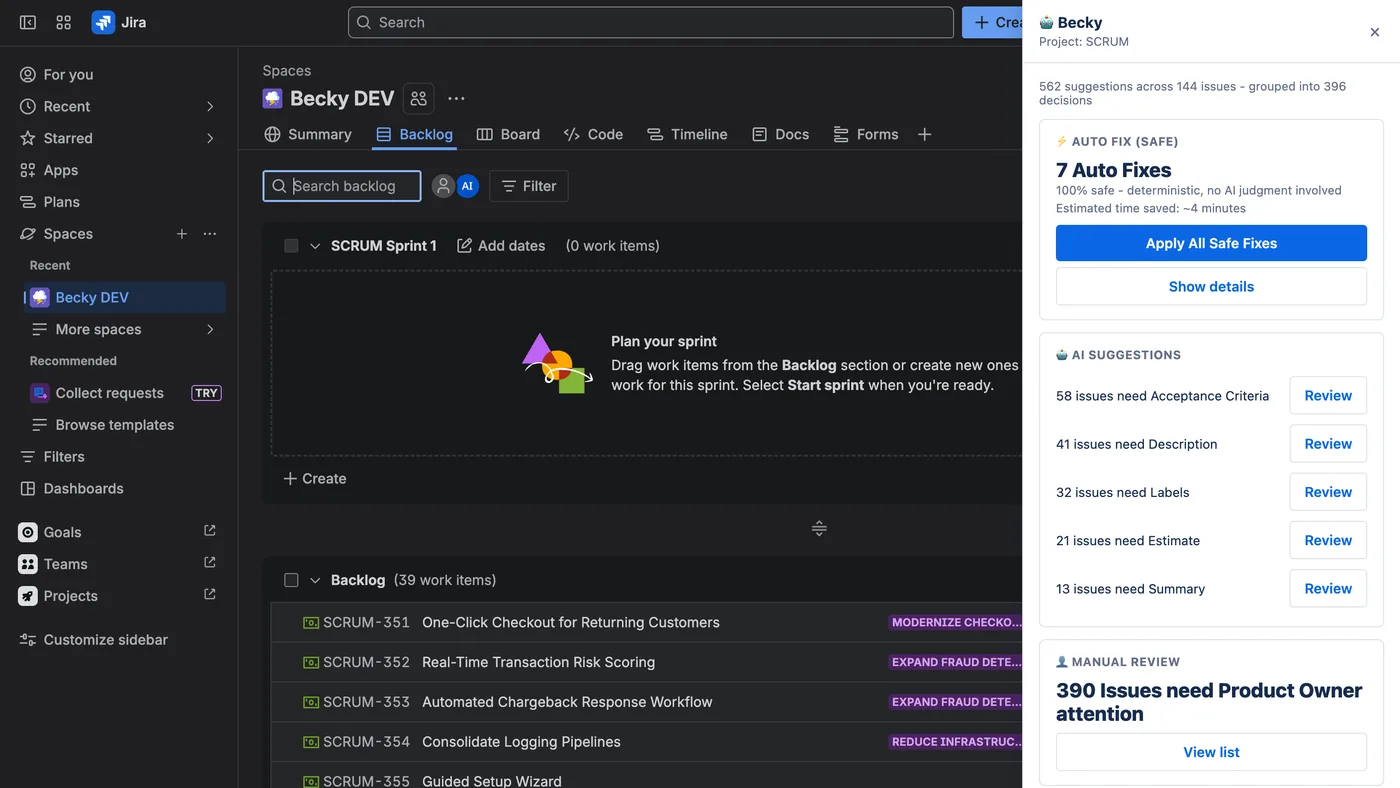
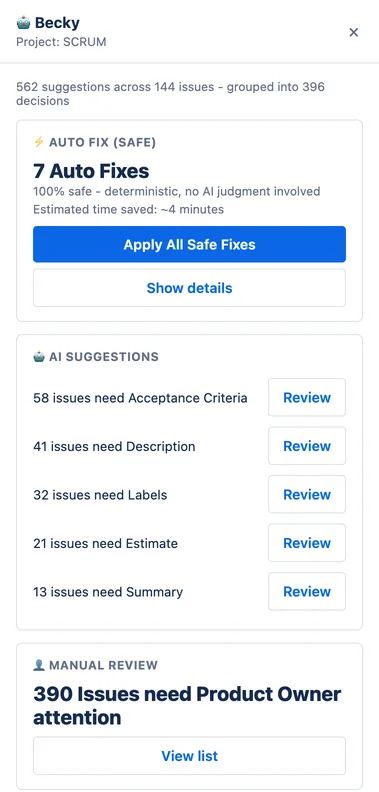
Not every fix deserves the same treatment. Every finding is sorted by how much judgment it needs, and each kind gets a different experience.
Deterministic
Auto Fix (Safe)
Rule-based changes with zero AI judgment.
- One summary, one action: Apply All Safe Fixes
AI-assisted
AI Suggestions
Missing content Becky can confidently draft.
- Reviewed one issue at a time
- Current vs. suggested, side by side
- Confidence and a “Why?” explanation
- Accept writes to Jira; Reject writes nothing
Human
Manual Review
Structural problems, or where AI has no confident signal.
- Grouped by owner
- Notify owners, or email the unassigned items
Decision 1
Review AI like a pull request
An earlier version listed AI suggestions as checkboxes grouped by field, applied later in one step. The redesign groups them by issue, so an issue with two drafted fields is reviewed once, and moves through them like a code review: previous, next, and status for each one.
Why It matches what actually reduces a product manager’s effort.
Decision 2
Show the least confident number
When one issue has several drafted fields, the confidence shown is the lowest of them, with the reasoning one click away.
Decision 3
Write exactly what was reviewed
Accepting sends back the exact values the person saw — nothing is regenerated at write time.
Governance model
-
The organisation’s rules, not ours
Consistent with the organisation’s own conventions, not an arbitrary external standard.
-
Policy-driven, traceable, reversible
Any change Becky makes must be explainable, bound to policy, and undoable.
-
A hard constraint, not a nice-to-have
Becky writes to production project-management systems, so auditability and safety come first.
Inside Jira, not beside it
The prototype is a browser extension that adds one collapsible Becky panel to the real Jira page. It never recreates any part of Jira’s own interface, and its styles are isolated so neither side can affect the other. The screenshot at the top of this page shows it running on a demo backlog.
-
Analyze Backlog
Reading issues, running governance rules, running AI analysis
-
Backlog Health
A simple, transparent score, findings and recommended actions
-
Fix My Backlog
Findings sorted into safe fixes, AI suggestions and manual review
-
Review
Apply, accept or reject, notify owners
-
Review Complete
What was applied, rejected or failed, with retry
MVP strategy and current state
-
Jira first, read-only
Connect to a real Jira Cloud project and map every issue into Becky’s own platform-agnostic model.
Current milestone
-
Analysis and fixes
Governance rules and AI drafting, reviewed in the Jira panel.
Prototyped
-
More platforms
Azure DevOps, Monday.com, Linear — each a self-contained integration.
Planned
- A deliberately messy backlog
- A demo generator seeds a fictional payments company, “BeckyPay”, with 50 issues of inconsistent quality, and records which problems were injected — ground truth to check Becky’s analysis against.
- Build only what’s needed
- Every milestone ships something working and demonstrable; abstractions wait for a second real use case.
- AI-assisted development
- Built with an AI coding assistant working to my product and engineering ground rules.
- Validation
- Customer validation is the next step. Nothing here has been tested with customers yet.